Plan First: Outline and Site Strategy
Before you pick up a saw or price out cladding, map the journey. Outline of this guide:
– Site strategy and permissions
– Design and layout essentials
– Foundations, structure, and weatherproofing
– Insulation, ventilation, and energy
– Budget, timeline, and practical conclusion.
Beginning with the ground and the rules saves money later, because a garden office is not just a shed with a laptop; it is a small building with real loads, real moisture, and real utility needs.
Start with orientation. South and west aspects bring generous light, which can be welcome in winter yet harsh in summer; north light is softer and more consistent for screens; east gives bright mornings and calmer afternoons. Consider shading, too: deciduous trees can temper summer glare and let in winter sun. As a rule of thumb, aim for a window‑to‑floor ratio of about 20–30% for balanced daylight without excessive heat loss or gain, adjusting for climate and glazing performance.
Next, site constraints. Measure setbacks from boundaries, overhead lines, and underground services. Keep an eye on drainage routes, mature roots, and prevailing winds. Elevating the floor above grade reduces splashback and damp, and a gravel strip around the perimeter helps break capillary moisture. Plan a modest, permeable path for year‑round access; icy lawns in January are no friend to laptop bags.
Local rules vary. Some areas allow outbuildings under set height and footprint limits without a full permit, while others require approvals for almost anything with permanent services. Typical triggers for permits include: electrical trenching, plumbing, height over roughly 2.5–3.0 m near a boundary, or floor area beyond small-structure exemptions. Check fire separation requirements if placing close to fences or neighboring structures. It is wise to document: site plan, elevations, structural notes, and an electrical schematic—clear paperwork speeds approvals.
Finally, utilities planning. Decide early whether you will install power, data, and optional water. Route trenches before landscaping, using proper depths, conduit, warning tape, and separation distances as required locally. Early planning here keeps you from reopening the garden twice. Think of this stage as laying the chessboard; good positions now make every later move simpler and safer.
Design and Layout Essentials: Light, Space, and Flow
Design is where purpose meets comfort. Start with the brief: solo workstation, two‑person studio, or flexible retreat that doubles as hobby space? Common footprints for compact offices range from about 2.4 × 3.0 m (cozy desk room) to 3.0 × 4.8 m (more generous with storage and a small meeting nook). Sketch furniture to scale and leave real circulation: at least 800–900 mm clear paths feel natural, while 1,000 mm adds easy turning and carrying space.
Place the main desk where glare is predictable and manageable. A side‑lit arrangement often beats direct front or back lighting for screens. Consider task zoning:
– Focus zone: desk, ergonomic chair, and controlled light
– Storage zone: tall units or built‑ins on the shadiest wall
– Refresh zone: a stool, shelf, or compact bench by a view to rest eyes
– Tech zone: router, patch panel, and charging tucked into a ventilated cabinet.
Glazing is about views and thermal balance. Double glazing with low‑emissivity coatings can achieve window U‑values around 1.2–1.6 W/m²K, while higher‑performance units can drop closer to 0.8–1.0 W/m²K. Consider opening lights on opposing walls for cross‑ventilation, and a high vent or clerestory for stack effect. Doors with multi‑point locks help both security and airtightness. If you aim for all‑season use, prioritize air sealing; a tiny uncontrolled gap equals a surprising heat leak in winter and a dust path in summer.
Sound matters. If your neighborhood is lively, add acoustic layers: staggered studs or resilient channels, dense insulation (mineral wool is effective), and careful sealing around outlets. Inside, soft finishes tame echoes: cork pinboards, fabric panels, or a generous rug. For ceiling finishes, simple painted plasterboard is clean and bright; timber slats add warmth and can conceal acoustic fleece behind.
Design for longevity and adaptability. Provide generous cable conduits, add blocking in walls for future shelves, and keep the interior palette calm so it works for office days and weekend tinkering. A garden office should feel like a quiet companion—use textures that age gracefully and windows that frame greenery, because a view of leaves is a daily productivity boost you never have to recharge.
Foundation, Structure, and Weatherproofing: Building for Decades
Foundations carry the story of the building, and soil conditions write the prologue. On firm, well‑drained ground, several options perform reliably:
– Ground screws: fast installation, minimal excavation, adjustable, suitable for sloping sites
– Concrete piers or pads: straightforward, cost‑effective, with careful layout
– Reinforced slab: robust, adds thermal mass, but higher embodied carbon and more site work.
A small office of 8–15 m² commonly sits on screws or piers; a slab earns consideration for heavier loads or integrated finish floors.
Structure choices include timber framing (versatile, easy to insulate), engineered lumber for long spans, or light‑gauge steel if moisture or pests are concerns. Timber remains popular thanks to its favorable strength‑to‑weight ratio and the ease of on‑site adjustments. Whatever the frame, maintain clear moisture lines: a capillary break above foundations, a ventilated subfloor where applicable, and a continuous weather‑resistive barrier on walls.
Cladding sets both tone and durability. Options include:
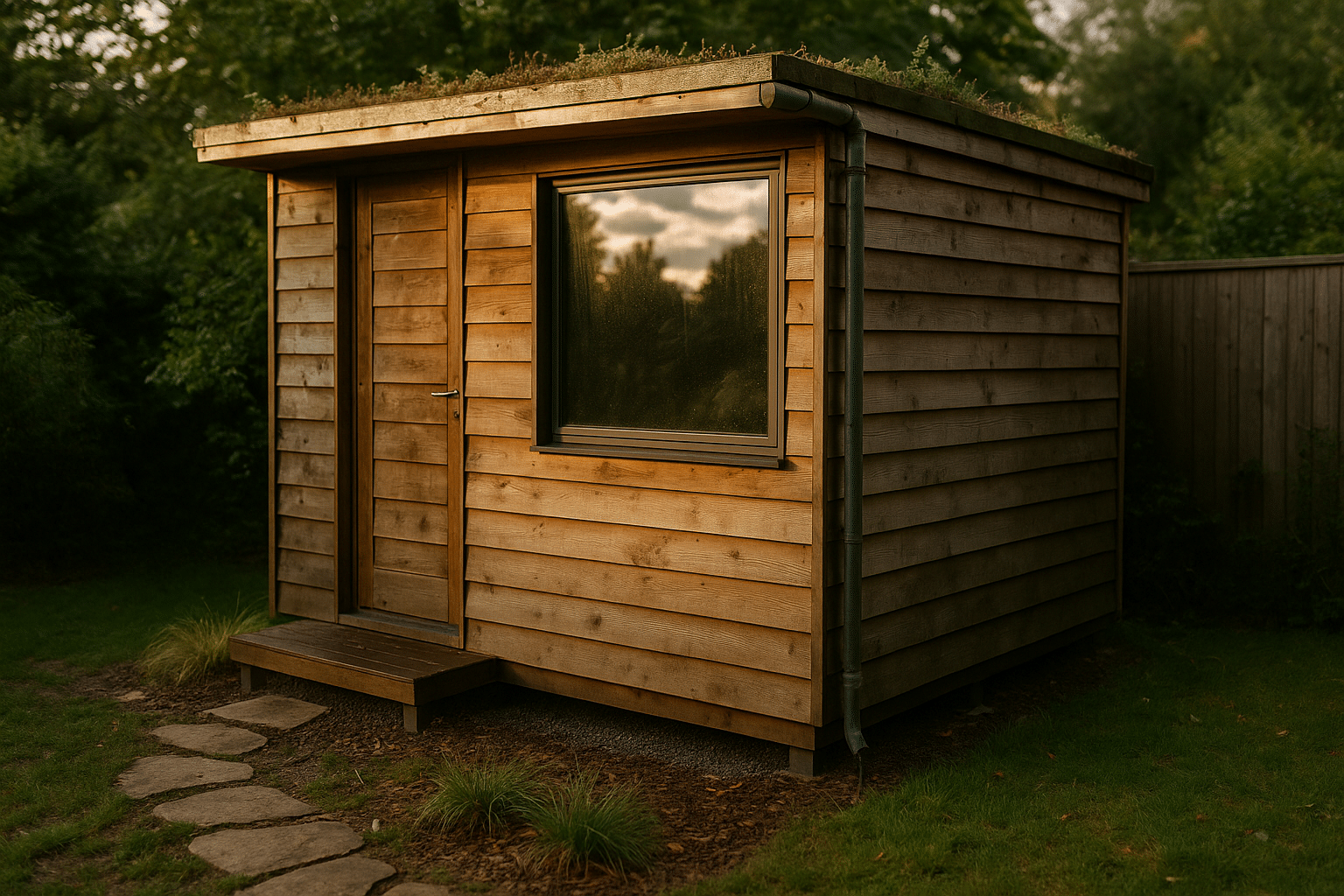
– Timber boards: warm, repairable; specify durable species or treated grades and detail drip edges
– Fiber‑cement: stable and low‑maintenance; needs precise flashing
– Metal sheets: crisp lines and rapid shedding of rain; good in harsh weather with care at edges.
Use ventilated rainscreen gaps (often 20–40 mm) to drain and dry behind cladding, and protect corners with robust trims. Good detailing beats thick materials when it comes to staying dry.
Roofs deserve extra attention. A low‑slope roof with a single‑piece rubber or similar membrane reduces seams; pitched roofs shed water and snow decisively and can host generous insulation depth. Whichever you choose, specify:
– Overhangs to shield walls
– Proper falls (often 1:40 to 1:80 for low‑slope)
– Continuous air and vapor control layers, lapped and taped
– Gutters sized for local rainfall and leaf guards if you live under trees.
A simple leaf‑grit path, a solid threshold, and a canopy give you a dignified arrival even in a downpour.
Weather is relentless but predictable. Build for your climate’s extremes: wind uplift ties on the roof, corrosion‑resistant fasteners near coasts, insect mesh at vents, and snow load checks in colder regions. When each layer—foundation, frame, barrier, cladding—does its job, maintenance becomes seasonal ritual rather than emergency repair.
Insulation, Ventilation, and Energy: Comfort Without Waste
Thermal performance is comfort you can measure. Wall assemblies aiming for year‑round use often target U‑values around 0.18–0.28 W/m²K (the lower, the better), achieved with continuous insulation or well‑filled studs plus a thermal break. Common insulants:
– Mineral wool: fire‑resistant, sound‑damping, easy to fit
– PIR rigid boards: high R per thickness, useful where depth is limited
– Cellulose: recycled content, excellent for dense‑pack cavities
– Wood fiber: vapor‑open, adds hygrothermal buffering.
Avoid thermal bridges at corners, around windows, and where floor meets wall; small breaks add up to big savings.
Control moisture with intention. A continuous air barrier stops drafts and protects insulation performance. On the warm side in cold seasons, a smart vapor retarder can limit diffusion when humidity is high and open when it is low, helping the assembly dry. Tape every seam as if you were sealing a tent before a storm; the work is fiddly, but the payoff is quiet, even temperatures and clean indoor air.
Ventilation keeps brains and buildings fresh. At minimum, plan secure trickle vents and a small, quiet exhaust fan. For all‑day occupancy, a compact heat‑recovery ventilator can exchange stale air for fresh while recapturing a portion of heat; even modest recovery (60–75%) reduces winter heating spikes and summer stuffiness. Cross‑vent windows placed high and low, opposite each other, give a welcome breeze on mild days.
Heating and cooling can be simple. Options include:
– Convection panel or oil‑filled radiator: low install effort, responsive zone heat
– Infrared panel: direct warmth for desk work with modest loads
– Small heat pump: efficient heating and cooling, useful in varied climates.
A typical 10–12 m² well‑insulated office might need 0.8–1.5 kW on the coldest days; sizing modestly and pairing with a timer and thermostat prevents overshoot.
Power and data deserve a clean plan. Run a dedicated circuit from the main board, bury conduit at locally required depths (often in the range of 450–600 mm), and include an exterior isolator. Provide plenty of outlets at desk height, USB‑C for devices, and hard‑wired ethernet for stability. If you’re considering solar, a compact array (for instance 1–2 kW) with an appropriately sized inverter can offset daytime use; pair with shading analysis to see if trees or neighboring roofs reduce yield. Efficiency first, though: tight envelope, thoughtful glazing, and LED task lighting make every watt work harder.
Budget, Build Timeline, and Practical Conclusion
Good projects are honest about money and time. Break the budget into clear buckets:
– Site prep and foundations: ground clearance, screws or piers, drainage
– Shell and structure: frame, sheathing, weather barrier
– Windows and doors: glazed units and secure locks
– Services: electrical trenching, cabling, fixtures, data
– Interior finishes: plasterboard, flooring, paint, cabinetry
– Exterior finishes: cladding, trims, gutters, deck or step
– Contingency: 10–15% for surprises.
This structure helps you scale scope up or down without losing the plot.
What do numbers look like in practice? Costs vary widely by location and specification, but a compact insulated office often allocates a notable portion to windows/doors and to the envelope’s airtightness work—areas that directly affect comfort and running costs. Saving on unseen details like membranes can feel tempting, yet those quiet layers pay you back every single day you occupy the space.
Timeline, from first sketch to first coffee at the new desk, typically follows:
– Weeks 1–2: site study, concept sketches, approvals check
– Weeks 3–4: detailed drawings, quotes, and ordering long‑lead items
– Weeks 5–7: foundations and shell
– Weeks 8–9: windows/doors, services rough‑in, and weatherproofing
– Weeks 10–12: insulation, linings, finishes, and commissioning.
DIY approaches stretch timelines but can trim costs; hiring specialists compresses time and risk. A hybrid route is popular: self‑performing finishes while bringing in pros for structure and electrics.
Risk management is unglamorous and invaluable. Photograph every layer before it’s covered, label circuits and conduits, and store spare cladding boards and a small box of matching screws. Schedule a check after the first heavy rain and the first hard frost. Plan maintenance as a calendar event—wash gutters each autumn, refresh exterior coatings per manufacturer guidance, and inspect seals annually.
Conclusion—turning vision into everyday calm. A garden office works when the envelope is tight, the light is kind, and the budget is honest. Choose materials that weather well, detail for drying, and invest where comfort is created: insulation, glazing, and ventilation. If you value quiet focus, a short walk to a purpose‑built room beats the longest commute. Build thoughtfully, and your garden office will become a trusted rhythm in your day—welcoming in the morning and contentedly silent at night.